Why Troina?
Part Two of the question: Why here? What is it about Troina that drew us here?
How Did We Get Here
The town of Troina first came to our attention when planning a month-long visit to Sicily a few years ago and we learned of the Italian 1 Euro House Project. The proposal sounded adventurous: In exchange for a buck (actually $1.09 currently), you get to transform a rundown, old, uninhabitable house in some antiquated Italian city-center into a something livable, full of beauty, life and purpose (la casa bella, Italians would say). Movies had been made of such endeavors. Books written. Lives changed.
In the end, the amount of work involved in the kind of full-scale renovation project required—think: no roof, no plumbing, no power—held little appeal for us as we were about to be, for the first time in our thirty years together, alone, just the two of us, without children and the many other fulfilling pursuits, proposals and possibilities a busy life conveys. Why gunk that up with a project of such eye-popping magnitude? And besides that, as far as our children are concerned, our move to Sicily has been, in our opinion, a masterclass in longing, purpose and finding your place in the world, and, in the words of comedian George Carlin:
“If your kid needs a role model and you ain't it, you're both fucked.”
Though we didn’t pursue the one euro house, the towns where these houses were (and still are) found hold up their end of the bargain as they are beautiful places off the beaten path and as such present not only a more affordable option but also the kind of larger world you find when you live in a small town. Places such as Penne in Abruzzo, Taranto in Puglia, Chiaramonte in Basilicata (all on mainland Italy) and in Sicily: Sambuca di Sicilia, Gangi, Petralia Soprana, and of course, Troina.
The First Norman Capital of Sicily
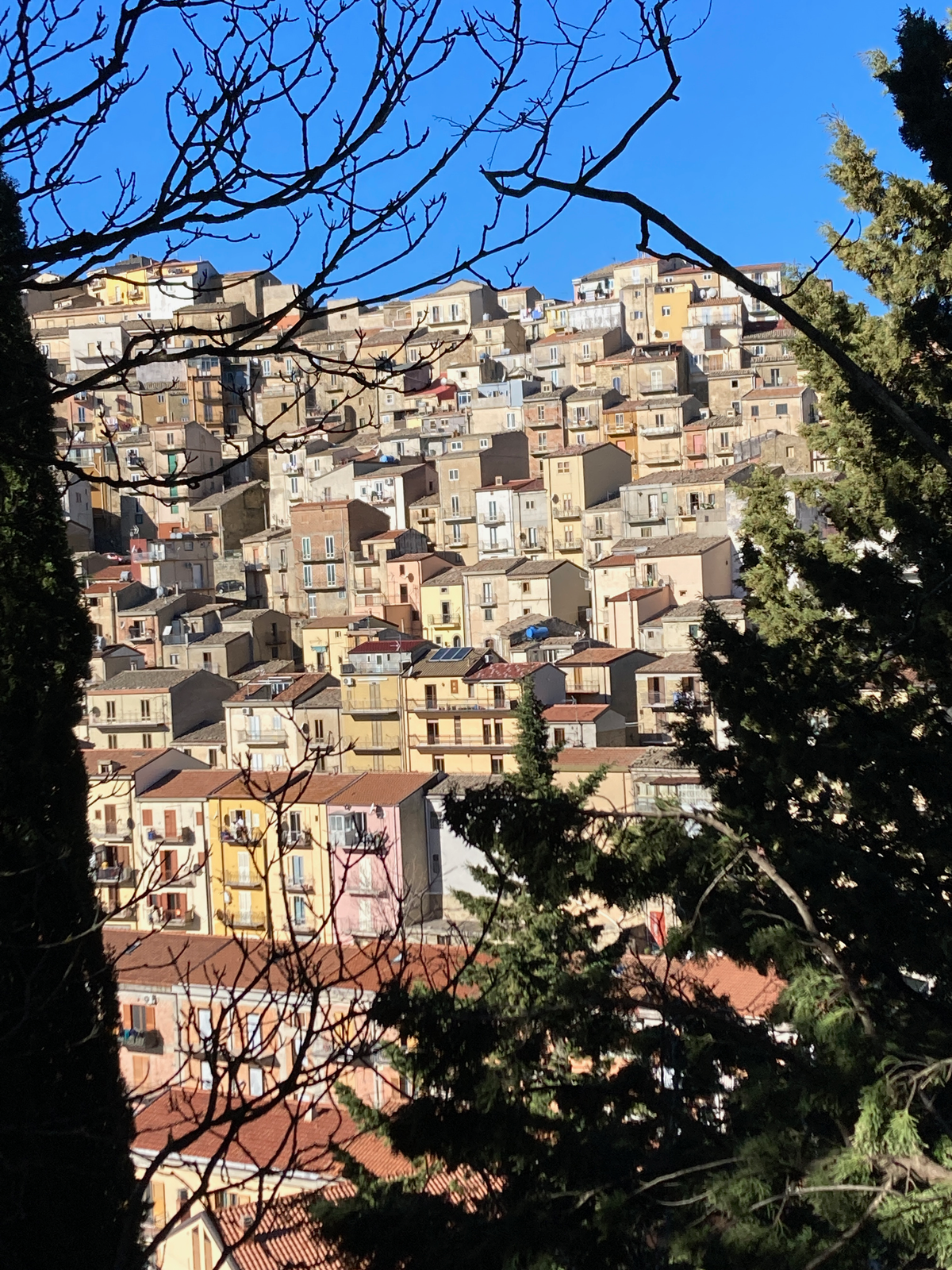
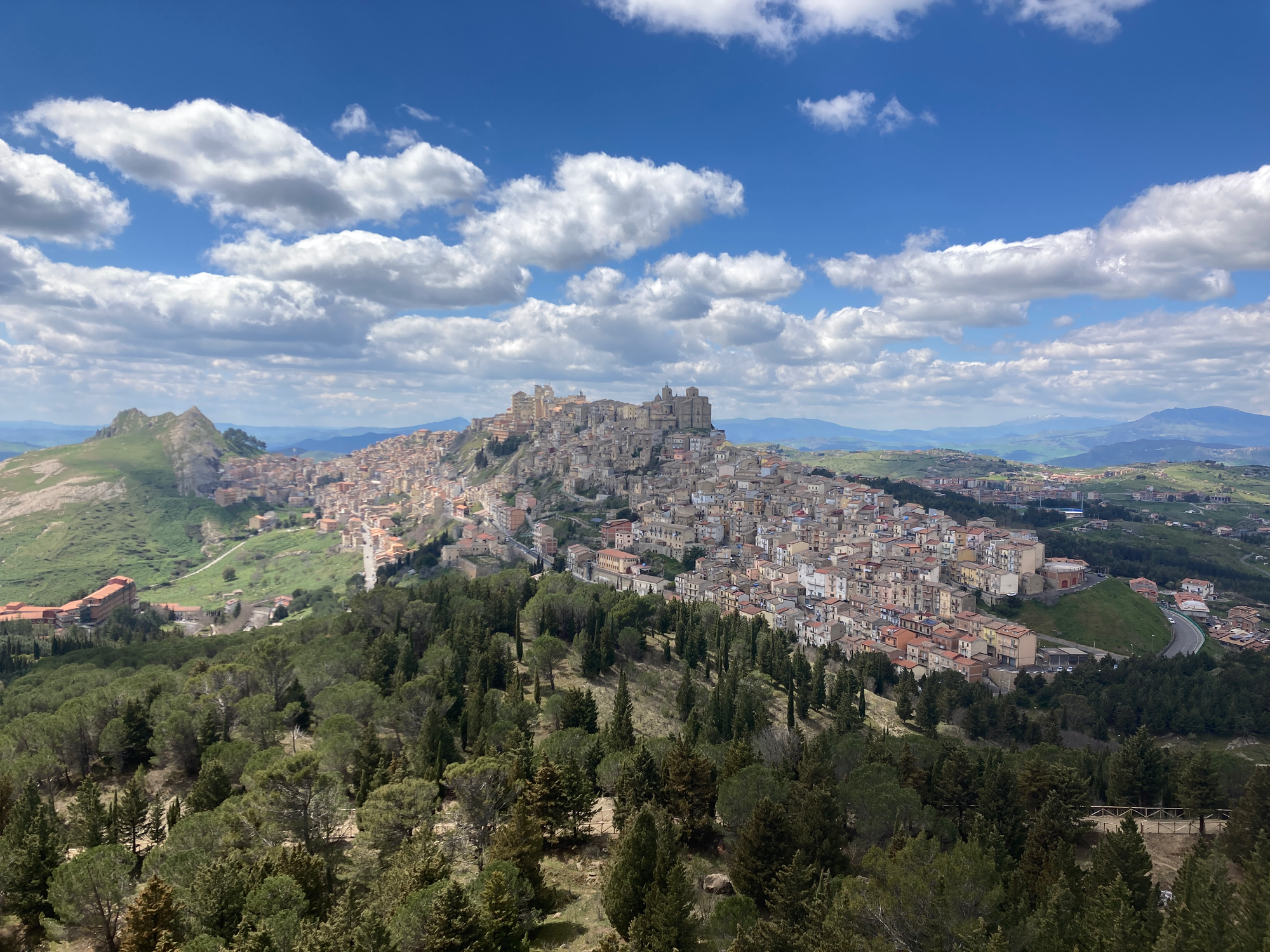
Interest in Troina is nothing new. Over the millennia it has attracted its fair share of attention, serving as the first Norman capital of Sicily from which the Gran Conte Ruggero conducted his conquest over the Arabs in 1000 AD. Many centuries later, in World War II, it became one of the last German strongholds on the island, requiring six days of intense fighting to liberate. Add to these the remains of a walled fortification recalling the Graeco-Roman city that existed in the 4th century BCE, and yeah, you start to get the picture: Troina is something special.
panoramic view of Troina, Sicily
But this is Sicily and describing a place by what it once was can in no way describe it as what it is now, and certainly not what it may become. Especially as it relates to invaders, occupiers, or even just a couple of fresh, middle-aged immigrants, one of whom is, ancestrally-speaking, no stranger at all to Sicily.
History here is marked on the genomes and memories of generations of Sicilians, an unbroken tenuous strain infiltrating the consciousness of today, rooted deeply in the soul of this life they hold so dear. Take this quote from Giuseppe Tomasi di Lampedusa, author of the sweeping novel, The Leopard, which chronicles the changes in Sicilian life and society during the unification of Italy:
This violence of landscape, this cruelty of climate, this continual tension in everything, and even these monuments of the past, magnificent yet incomprehensible because not built by us and yet standing round us like lovely mute ghosts; all those rulers who landed by main force from every direction who were at once obeyed, soon detested, and always misunderstood, their only expressions works of art we couldn't understand and taxes which we understood only too well and which they spent elsewhere: all these things have formed our character, which is thus conditioned by events outside our control as well as by a terrifying insularity of mind.
The Pain of the Past
Ma ogni mali nun veni pri nòciri. But not every pain comes to harm you, goes an old Sicilian proverb. What we have found here is neither tense, nor suspicious, and definitely not narrowmindedness. Our friends here know what they have. When asked why we’re here and we move past the wild terrain (look around) and tell them we want what they have, too, they understand completely.
The stuff of the simplest of pleasures: Food, wine, heirloom recipes. Quiet afternoons and tranquil, communal evenings. Traditions dating back centuries. The aspiration, emotion, morality and conflict of our shared human condition and all of its weathered veracity. It's all here.
Some of those friends have left, of course, lured by the promise of some other place, or for work or some other adventure, only to return because to have lived here is to never be free from the nostalgia for it. Like many of the places you yourself call home. Or places we, too, have called home.
The thought of such comings and goings weighs heavily on our minds. With our children and family, especially. But also with these friends of ours. What if they leave again? Or if the lady from whom we buy vegetables closes shop? Or the bookseller moves to a bigger market? Or a hundred other possibilities in which we might find ourselves alone. Just the two of us.
But then I remember, isn’t that the point? Just the two of us—if only for now, for this particular time being.
The past is a primitive thing, especially our need to be part of something larger, something bigger than just ourselves, and throughout the millennia it has helped shape our identity, influence our values, and modify our behavior. But also it has instilled in us all the ability, confidence and path onto which we might eventually surrender to our longing, find meaningful purpose and only then discover our place in the world.
So maybe the question we should be asking ourselves is not is this place good for us, but are we good for this place.
It’s a question we’ll pursue next time in This is a Mistake.